Two possible destinations for a reliving soul after it leaves the body
Handling the UndeadTwo possible destinations for a reliving soul after it leaves the body is the distinction Flora uses to explain what may happen when a returned person's consciousness separates from the flesh. One route is collection by the Fisher; the other is disappearance. The novel gives no settled map of either destination, but makes the difference matter in its most intimate terms: whether the departing person is caught, or escapes beyond the reach of those who remain.
Definition and limits
The rule concerns the soul's departure from a body, not the body's physical condition alone. In the crisis, death has already become difficult to define biologically: the possibility that metabolism can restart unsettles the assumption that the cessation of bodily processes is final. Flora's account adds a separate question. Even when a body can be treated as an object that may be buried or burned, what remains of the person may still be capable of choosing, fearing, and leaving.
Flora does not present a doctrine learned through study. When she reaches Eva, she understands that a soul needs a body even for a simple act such as standing, while a body also requires a soul. The insight makes the emptied body legible to her as matter, but it does not disclose what lies beyond it. She knows only that souls may be collected or disappear; knowledge of the destination itself is unavailable until one is there. The Other Place remains more radically unknowable still, a place about which nothing can be said. The rule therefore supplies a choice of routes without turning the afterlife into a fully explained system.
Flora's intervention in Eva's departure
The rule becomes practical when Flora finds Eva in the hallway, bandaged across half her face and preparing to leave. Flora takes her by the shoulders and establishes a mental link, shutting out the surrounding commotion so that she can reach the part of Eva that remains within the body. Eva resists: she wants to live. Flora answers that this possibility has closed, and that there are two ways out. She transmits images of souls leaving their bodily bonds, one collected and one disappearing; the words and images seem to pass through her rather than originate in her own understanding.
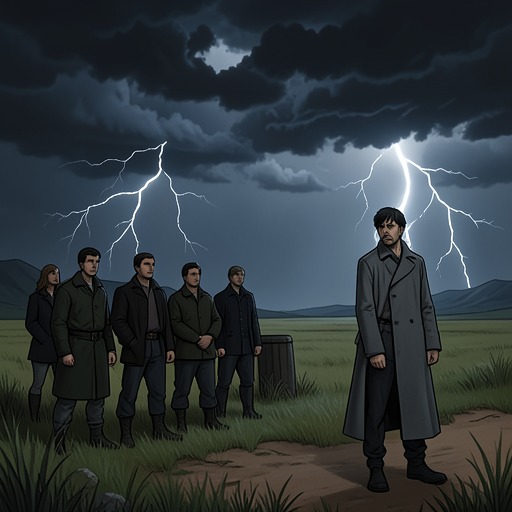
The explanation does not make the choice easy. Eva asks for time to say goodbye, and Flora urges her to surrender. As Eva's soul approaches the surface, the Fisher's whining grows louder. The image is predatory and precise: the Fisher has searched across the ocean and now descends toward its catch. The threat gives the distinction between the two destinations immediate force. Departure is not a quiet abstraction; it takes place under pressure, with the possibility of capture drawing close.
Eva escapes before the Fisher can take shape or claim her. Her soul leaps from her chest and flies away with a speed unavailable to the body. Flora senses a passing life and a flicker of consciousness, then Eva is gone and her body collapses at Flora's feet. The Fisher takes up the chase, but the scene does not reveal where Eva arrives or whether disappearance means safety. It establishes only that she has not been caught in the moment of leaving. Flora's brief good-luck wish marks the limit of her power: she can help Eva depart, but cannot follow or guarantee the outcome.
The Fisher and the living
David's encounter with a caterpillar gives the rule a contrasting, bodily form. After dreaming of a labyrinth and a pursuing figure that wears Eva's face, he wakes in Magnus's bed with a white caterpillar curled on his stomach. A whining sound fills the room, and a hook-bearing hand reaches toward the creature. David recognizes the presence as his own image of Death, the woman from the grocery store, while the caterpillar's plea comes to him in Eva's voice.
David cups his hands over the caterpillar and refuses to let it go. The hooks stop short of his hand because he is alive: they are not permitted to touch him. That limit separates the living from the departing dead even as the scene makes them physically adjacent. The caterpillar wriggles beneath David's palm and its plea reaches him through touch, as if the boundary between bodies does not prevent the dead from appealing to the living. His refusal is protective, but it also delays the creature's release; the caterpillar swells, looks sick, and weakens while he holds it.
When a hook finally pierces the caterpillar, its shell opens to reveal a pupa. A butterfly emerges, the dry casing falls away, and the butterfly flies upward through the ceiling. The hooks disappear and the whining abates. The transformation recalls the rule's alternative to collection, but the scene does not explicitly identify the butterfly with either destination. Its force lies instead in the change from trapped, vulnerable form to departure: David has witnessed something leave, and his act of holding on has not been able to preserve it.
Bodies, grief, and the meaning of release
Flora's reasoning after Eva's departure makes the rule's human cost explicit. Kneeling beside the vacant body, she recognizes that what remains can be burned or buried like rubbish, though this physical residue is not the person she has just helped escape. She has no answer to the larger questions of why people are born or what their destination means. The place souls are going cannot be understood from outside it, and the possibility of the Other Place cannot be described at all. Her new responsibility thus begins not with certainty, but with an act undertaken in the presence of radical ignorance.
David's response supplies a parallel consequence from the side of those left behind. After the butterfly vanishes, Magnus murmurs for his mother in his sleep. David leaves the room so as not to wake him, then lies on the kitchen floor and cries until he feels empty. The scene makes release more than a metaphysical outcome: it is also a demand imposed on the living, who may hear a plea from someone they love and still be unable to understand or accept what letting go entails.
The rule therefore holds together two truths the novel refuses to simplify. A body may remain after the person has departed, and a departing soul may face capture or disappear into what the living cannot know. Flora's brief intervention shows that the dead can still express a wish and that someone may help them act on it; David's refusal shows how love can become a grip that keeps the loved one in suffering. Neither scene offers a complete account of what follows. Instead, the two possible destinations give shape to the book's recurring tension between care and possession, and between the desire to save someone and the necessity of allowing departure.